Rio de Janeiro Maru
7.3044°N 151.8947°E · wreck
Rio de Janeiro Maru
A 140-meter passenger-cargo vessel turned submarine tender, lying on her starboard side at 33—35 meters — famous for her ornate engine order telegraph and the varied cargo in her holds including artillery shells and thousands of beer bottles.
Overview
The Rio de Janeiro Maru was a 140-meter (461 ft), 9,627-ton passenger-cargo vessel built in 1929 by Mitsubishi Shipyard in Nagasaki for Osaka Shosen Kaisha (OSK Line). She served routes between Japan, South America, and intermediate ports — hence her Brazilian name. The Imperial Japanese Navy requisitioned her in 1940—1941 and converted her into an auxiliary submarine depot ship. On February 17—18, 1944, during Operation Hailstone, she was struck by bombs and torpedoes from U.S. carrier aircraft. She sank and now rests on her starboard side at a maximum depth of approximately 33—35 meters near Uman Island.
The wreck is substantially intact on the upper port side, which now faces upward. Her most celebrated feature is the engine order telegraph on the bridge, which is among the most ornate and best-preserved in Chuuk. The holds contain a varied cargo: Hold 1 has artillery shells and ammunition; Hold 2 contains large gun barrels, gun turrets, coal, and cement bags; Hold 4 has additional gun components; and Hold 5 contains thousands of wooden-crated beer bottles — a surprisingly intimate reminder of the logistics that sustained Japan’s Pacific garrisons. Note: the wreck’s starboard-side orientation means interior navigation requires adapting to rotated spaces.
Site Information
- Location: Chuuk Lagoon, Chuuk State, Micronesia
- Entry Type: Boat dive
- Site Type: Wreck dive
- Difficulty Level: Intermediate
- Maximum Depth: 33 meters
- Typical Visibility: 15-30 meters (50-100 feet)
- Current: Generally mild inside the lagoon
- Best Time: Year-round; December to April for calmest conditions
Marine Life
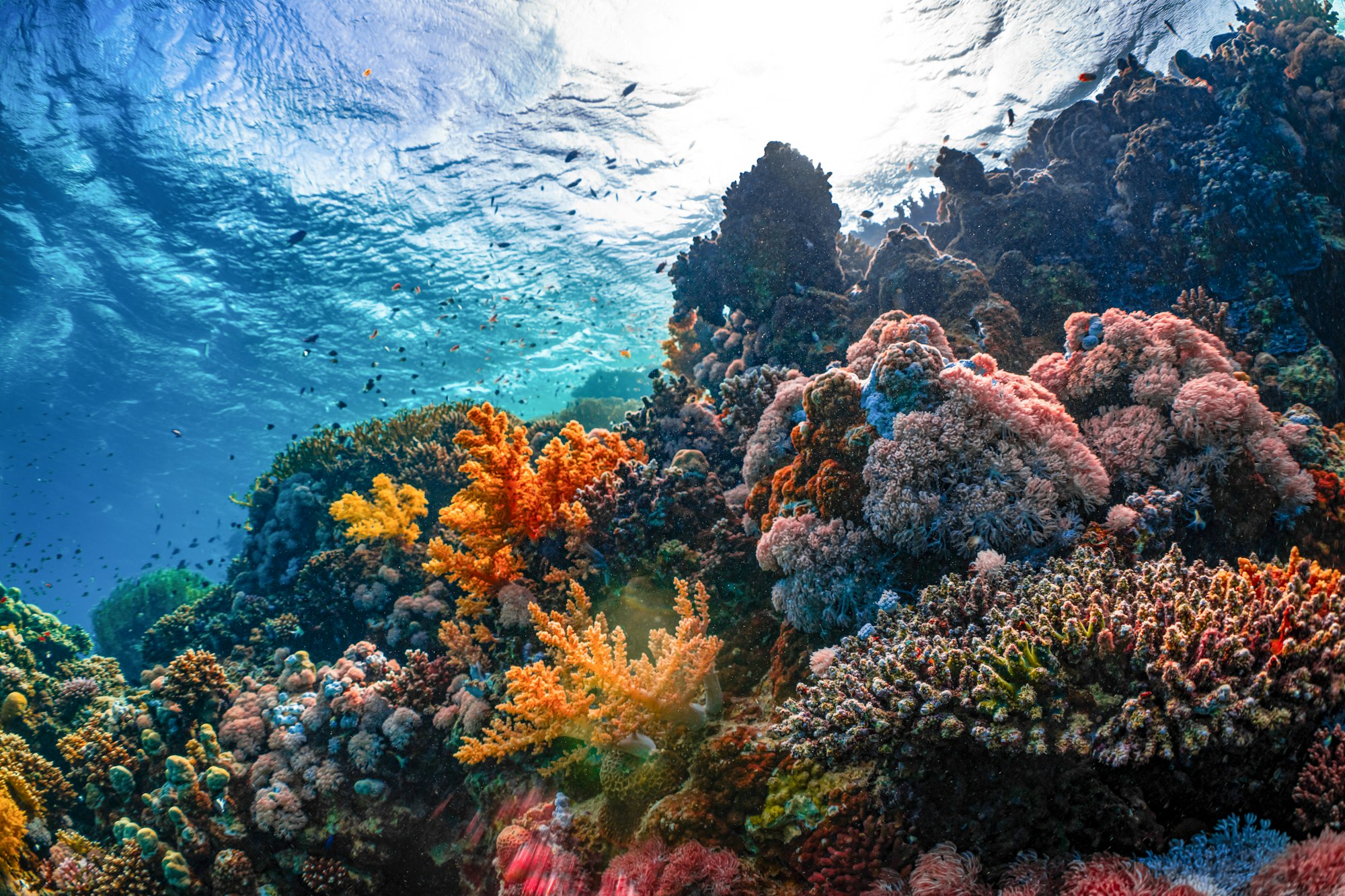
The Rio de Janeiro Maru supports healthy coral growth across her exposed port hull, which now faces upward. Hard corals, sponges, and sea fans encrust the railings, davits, and superstructure. Schools of batfish are commonly seen around the superstructure. Fusiliers and jacks patrol the open water nearby. Inside the holds and interior spaces, glassy sweepers form dense clouds. Lionfish and scorpionfish are found throughout. Whitetip reef sharks and grey reef sharks are documented in Chuuk Lagoon generally; no site-specific marine life reports for this wreck were found.
Dive Profile
The wreck lies on its starboard side, so the entry point is typically the exposed port hull, which is the shallowest accessible surface. The bridge area is a natural first stop — the engine order telegraph is beautifully preserved and makes an outstanding photography subject.
Move forward to explore the holds. Hold 5 at the aft section contains the thousands of beer bottles, packed in wooden crates. Holds 1 and 2 contain the gun barrels, turrets, and artillery shells. The holds descend to 30—35 meters at the deepest points. The wreck’s side-lying orientation means that original horizontal corridors are now vertical, and navigation requires mental adjustment.
The maximum depth reaches the lagoon floor at approximately 33—35 meters beside the starboard hull. Finish shallower on the exposed port side structure before ascending for your safety stop.
Entry and Exit
Boat dive from Weno-based operators, approximately 30 minutes to the site. A permanent mooring buoy is attached to the wreck. Enter by giant stride and descend the mooring line. Surface conditions in the lagoon are typically calm. Ascend the mooring line or deploy an SMB during your safety stop for pickup.
Tips and Recommendations
- The engine order telegraph is the signature photographic subject — beautifully preserved with legible characters
- The beer bottles in Hold 5 are worth exploring with a good torch, though do not disturb or remove anything
- The side-lying orientation makes this a more disorienting dive than upright wrecks — dive with a guide on your first visit
- Nitrox extends bottom time at shallower structural levels and is recommended
- This wreck pairs well with the nearby Sankisan Maru for a two-wreck dive day
Safety Considerations
The Rio de Janeiro Maru is a war grave — all artifacts, including the bottles and cargo in the holds, are legally protected. Do not touch, move, or remove anything. The holds contain military cargo and should be explored with care; silt on the hold floors can reduce visibility quickly with careless finning. Interior penetration beyond the open holds and bridge requires wreck certification and redundant lights. The side-lying orientation is the primary navigation hazard — original vertical spaces are now horizontal and vice versa; this increases disorientation risk. The 33—35 meter maximum depth limits bottom time on air. Maintain awareness of your depth and air supply throughout the dive.
Photography
The engine order telegraph is the signature photographic subject — beautifully preserved with legible characters. The beer bottles in Hold 5, stacked in wooden crates, create evocative still-life compositions. The gun barrels and turrets in Holds 1 and 2 make powerful cargo subjects with careful strobe positioning. The side-lying orientation of the wreck creates unusual angles and framing opportunities. Strobes are essential for the hold interiors. The exposed port hull receives good ambient light for coral encrustation shots.
Sources: Michael McFadyen’s Scuba Diving - Rio de Janeiro Maru, Scuba Diving Earth - Rio de Janeiro Maru, Dive3D - Rio de Janeiro Maru, Argunners - Rio de Janeiro Maru. Last updated 2026-05-22.
Sea-surface temperature and wave height from Open-Meteo Marine (ERA5 reanalysis, monthly averages).
942 verified species observations (175 species) logged within ~11 km of this site between 1960 and 2014, from the Ocean Biodiversity Information System.
- Ctenochaetus striatus · Small-bodied acanthurid
- Chlorurus bleekeri · Small-bodied parrotfish
- Siganus puellus · Rabbitfish
- Acanthurus thompsoni · Small-bodied acanthurid
- Scaridae · Small-bodied parrotfish
- Scarus rivulatus · Small-bodied parrotfish
- Chordata
- Monotaxis grandoculis · Large-bodied emperor
- Chlorurus sordidus · Small-bodied parrotfish
- Scarus oviceps · Small-bodied parrotfish
- Scarus dimidiatus · Small-bodied parrotfish
- Scarus ghobban · Large-bodied parrotfish
Scientific survey records skew toward sampled taxa (molluscs, corals) and do not reflect what you are guaranteed to see on a dive.
Source: OBIS (obis.org), aggregated Darwin Core occurrence records.
Conditions change with the tide and the season. If you have dived this site, share what it was actually like — date, visibility, current, and what you saw. Real, recent reports from divers are exactly what this guide is built to collect.
Send a conditions report ›