Sankisan Maru
7.2955°N 151.8689°E · wreck
Sankisan Maru
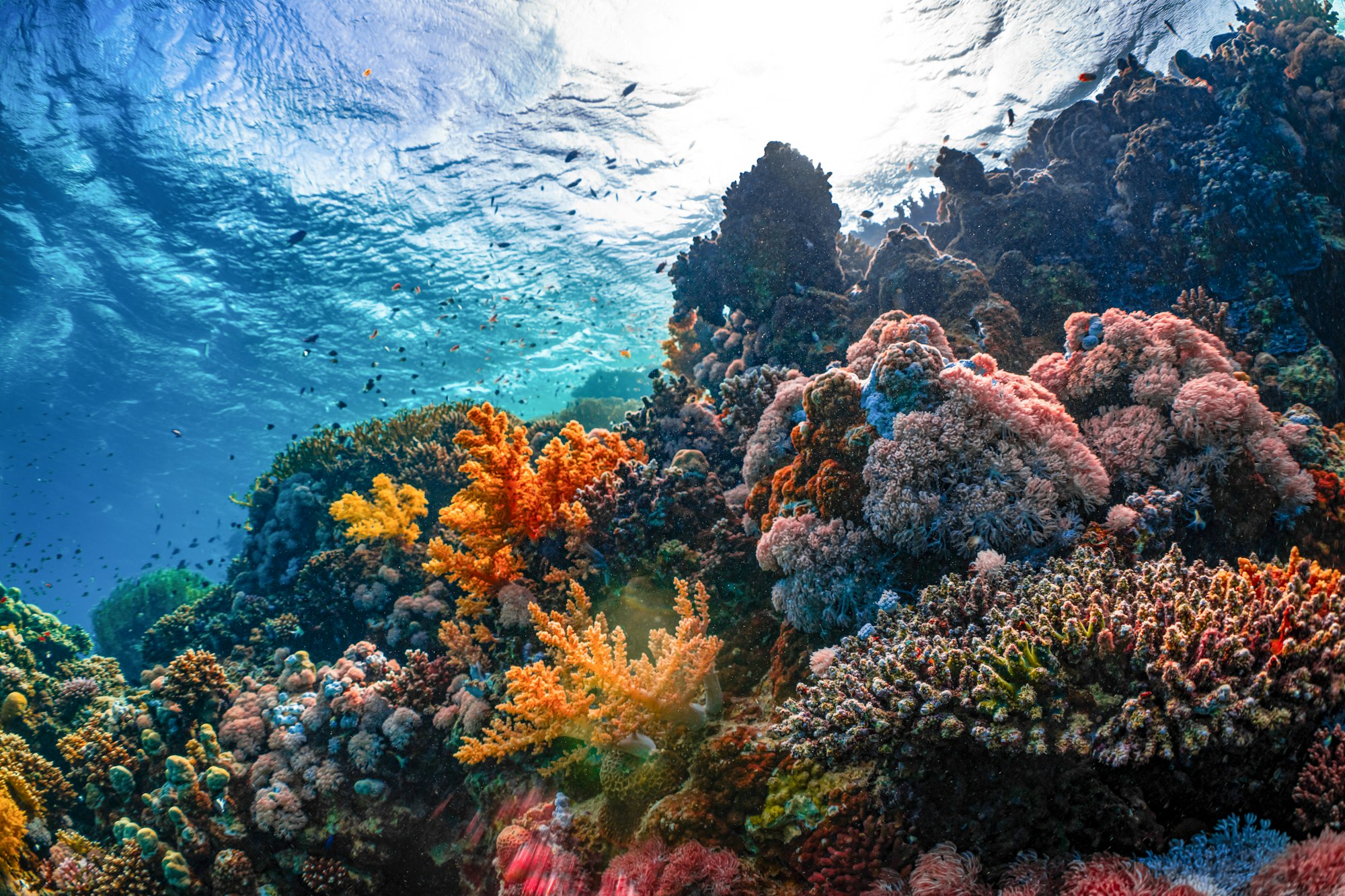
A 112-meter cargo vessel with aircraft engines, ammunition, and truck chassis in her holds — and some of the finest soft coral growth in Chuuk Lagoon on her masts and superstructure.
Overview
The Sankisan Maru was a 112-meter, 4,776-ton cargo vessel built in 1920 and captured from Allied interests in 1942, then pressed into service as a military supply transport for the Imperial Japanese Navy. On February 17—18, 1944, during Operation Hailstone, a bomb struck the aft hold where ammunition was stored. The resulting explosion was catastrophic, ripping the stern section away and creating a 500-foot-diameter crater on the lagoon floor. The forward section remains upright and intact, with the bow at just 1 meter below the surface; the destroyed stern section lies scattered at approximately 48 meters.
Multiple independent sources (Thorfinn, Dirty Dozen Expeditions, Dive3D) confirm the hold contents are: mixed ordnance and small-arms ammunition in Hold 1; three radial aircraft engines, aircraft cowlings, exhausts, and wheel assemblies in Hold 2; and truck chassis, machine guns, propeller blades, and ammunition throughout the remaining holds. No independent source consulted during this QA pass confirms “rows of aerial bombs” as a feature of this wreck — that description has been removed as unverified. The Sankisan Maru’s masts and upper superstructure carry some of the finest soft coral growth in Chuuk Lagoon, rivalling the Shinkoku Maru in density.
Site Information
- Location: Chuuk Lagoon, Chuuk State, Micronesia
- Entry Type: Boat dive
- Site Type: Wreck dive
- Difficulty Level: Intermediate
- Maximum Depth: 30 meters
- Typical Visibility: 15-30 meters (50-100 feet)
- Current: Generally mild inside the lagoon
- Best Time: Year-round; December to April for calmest conditions
Marine Life
The Sankisan Maru’s masts and upper superstructure carry some of the finest soft coral growth in Chuuk Lagoon — multiple dive operators rate it comparable to the Shinkoku Maru. Hard corals and sea fans cover the railings, king posts, and exposed deck structures. Soft corals add vivid color to the shallower sections above 15 meters.
Schools of batfish frequent the superstructure area. Fusiliers and anthias cloud the upper works. Inside the holds, glassy sweepers form dense schools. Lionfish are common in the shadows. Nudibranchs and flatworms inhabit the encrusted hull surfaces. Reef fish typical of Chuuk Lagoon wrecks are present; no site-specific marine life reports were found beyond these general categories.
Dive Profile
The forward bow section is the accessible part of the wreck, with the bow at only 1 meter below the surface. Descend along the forward section to the mast structure and superstructure at 12—20 meters, where the soft coral growth is exceptional. Hold 1 contains mixed ordnance and small-arms ammunition; Hold 2 holds three radial aircraft engines plus cowlings and exhaust components — these are the standout hold features. Truck chassis, machine guns, and propeller blades are distributed through the remaining holds.
The destroyed stern section lies scattered at approximately 48 meters, where a large crater marks the explosion site. The bridge-to-stern section was obliterated in the explosion; only the forward hull is intact and accessible for standard recreational diving. Use the shallow mast and superstructure areas for safety stops at 3—10 meters — this is where the soft coral growth is finest.
Entry and Exit
Boat dive from Weno-based operators, approximately 30-40 minutes to the site. A permanent mooring buoy marks the wreck. Enter by giant stride and descend the mooring line. Surface conditions are typically calm in the sheltered lagoon. Ascend via the mooring line and complete your safety stop at 5 meters.
Tips and Recommendations
- The soft coral growth on the masts and superstructure is the star feature — plan time here at shallow depth
- The aircraft engines in Hold 2 are the best hold subject — carry a torch to pick out engine detail in the lower hold sections
- The near-surface bow (1 meter) is an interesting snorkeling option and makes a great reference point for descending
- The shallow deck depth makes this an excellent Nitrox dive with significantly extended bottom time
- The Sankisan pairs well with the nearby Rio de Janeiro Maru for a two-wreck day
- The destroyed stern section at 48 meters is for advanced divers only; the forward bow section is accessible to Open Water divers
Safety Considerations
The Sankisan Maru is a war grave — artifact removal is illegal. The holds contain live ordnance including ammunition and aircraft components that may include unstable materials; do not touch or disturb any items. Note: the wreck depth range is more complex than it first appears. The forward bow section is accessible from near the surface down to approximately 20—30 meters; but the destroyed stern debris lies at 48 meters in and around the explosion crater. Silt on hold floors can reduce visibility rapidly. The wreck structure is aging and some sections may be weakened — avoid contact with overhead structure inside the wreck. Interior penetration beyond the open holds requires wreck certification.
Photography
The soft coral-encrusted masts and superstructure at shallow depth are the primary photographic attraction — wide-angle shots in natural light capture the vivid colors against blue water. The radial aircraft engines in Hold 2 reward careful strobe work. The near-surface bow provides unusual wide-angle perspectives of wreck structure bathed in full sunlight. The explosion crater at the stern and surrounding debris field make dramatic wide-angle subjects for divers with the experience to reach 48 meters. The manageable forward section depth and good ambient light make this one of the easier Chuuk wrecks to photograph well.
Sources: SS Thorfinn - Sankisan Maru, Dirty Dozen Expeditions - Wrecks Above 40m, Dive3D - Sankisan Maru, Scuba Diving Earth - Sankisan Maru. Last updated 2026-05-22.
Sea-surface temperature and wave height from Open-Meteo Marine (ERA5 reanalysis, monthly averages).
1149 verified species observations (161 species) logged within ~11 km of this site between 1960 and 2014, from the Ocean Biodiversity Information System.
- Ctenochaetus striatus · Small-bodied acanthurid
- Chlorurus bleekeri · Small-bodied parrotfish
- Siganus puellus · Rabbitfish
- Scaridae · Small-bodied parrotfish
- Acanthurus thompsoni · Small-bodied acanthurid
- Scarus rivulatus · Small-bodied parrotfish
- Hipposcarus longiceps · Large-bodied parrotfish
- Scarus dimidiatus · Small-bodied parrotfish
- Chordata
- Monotaxis grandoculis · Large-bodied emperor
- Chlorurus sordidus · Small-bodied parrotfish
- Scarus oviceps · Small-bodied parrotfish
Scientific survey records skew toward sampled taxa (molluscs, corals) and do not reflect what you are guaranteed to see on a dive.
Source: OBIS (obis.org), aggregated Darwin Core occurrence records.
Conditions change with the tide and the season. If you have dived this site, share what it was actually like — date, visibility, current, and what you saw. Real, recent reports from divers are exactly what this guide is built to collect.
Send a conditions report ›