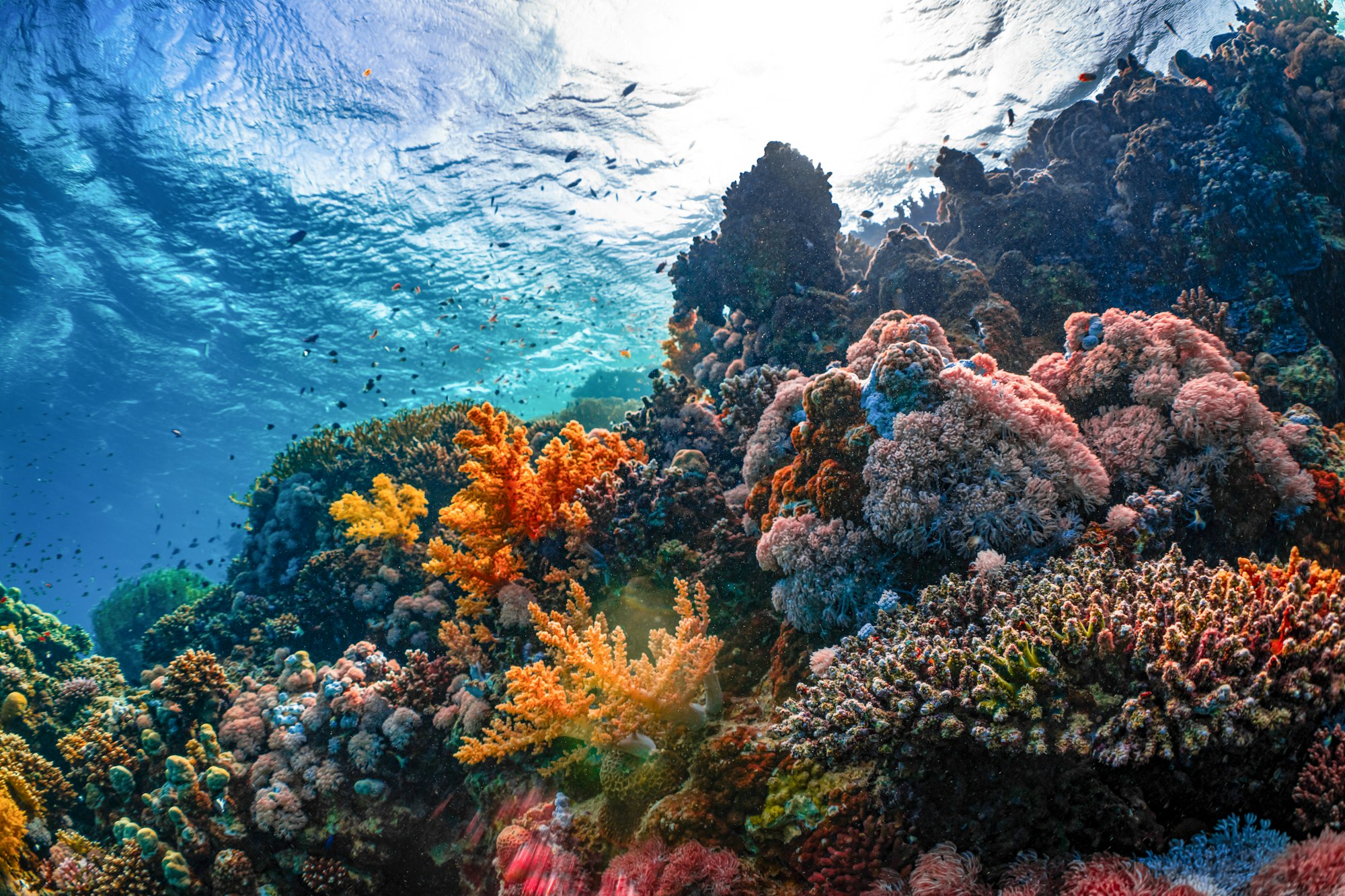
Fish Head
3.9445°N 72.9318°E · thila
Fish Head (Mushimasmingili Thila) is a protected pinnacle in North Ari Atoll and one of the Maldives' best shark dives — resident grey reef sharks patrol its current-swept walls from a 10 m reef top down past 35 m. An advanced drift dive.
Overview
Fish Head — known locally as Mushimasmingili Thila — is one of the Maldives’ most celebrated dives and, for many divers, the finest shark dive in North Ari Atoll. It is a submerged pinnacle (thila) that rises from the atoll floor to a reef top around 10–14 m, its steep walls dropping past 35 m and riddled with overhangs and caves. It has long been designated a Marine Protected Area: fishing is banned, and the shark feeding that first drew crowds here is now prohibited.
Why divers come
The draw is grey reef sharks. They patrol the current-swept walls in numbers rarely seen elsewhere in the Maldives — commonly ten to twenty on a single dive, sometimes many more — cruising in the blue off the pinnacle’s exposed faces. Add near-resident Napoleon wrasse over two metres long, hunting packs of giant trevally, barracuda storms and cave walls packed with blue-line snapper, and Fish Head earns its reputation as a big-fish arena.
The dive
Fish Head is dived as a drift. Guides read the current first — usually strongest, and best, on an incoming tide that pulls nutrients and pelagics onto the thila — then drop divers to work the walls with the flow. The reef top sits shallow enough for extended time among coral and fish schools, while the sharks and larger animals hold in the current along the deeper faces and corners. In strong flow the safety stop is often made in open water off the pinnacle, so a delayed surface marker buoy is essential.
Marine life
Grey reef sharks are the signature. You may also see white-tip and black-tip reef sharks, nurse sharks, the occasional hammerhead, eagle rays, resident Napoleon wrasse, hunting giant trevally, barracuda, and dense schools of fusilier and snapper, with hawksbill turtles on the reef. Manta rays and whale sharks are not a reliable feature here — for those, head to South Ari Atoll’s protected area.
Conditions & who should dive it
Current is the defining factor: moderate to strong, sometimes exceeding two knots and unpredictable. Visibility averages around 15 m and can reach 30 m in the dry season. This is an intermediate-to-advanced drift dive — most operators ask for an Advanced Open Water certification and around 30 logged dives, and it is not a site for newly certified divers. Always dived with a local guide who sets the entry on the current.
When to go
December to May — the northeast monsoon dry season — brings the calmest seas and best visibility, often 20–30 m. The southwest monsoon (roughly May–November) is greener but plankton-rich and biologically active. The site dives year-round, with the peak window December through May.
Getting there
Reached by liveaboard safari (nearly every North Ari / “Best of Maldives” itinerary includes it), by speedboat day trip from Ari Atoll resorts, or with local-island dive centres. Ellaidhoo is among the closest resort islands.
A note on protection
Fish Head is a no-take Marine Protected Area. Do not fish, touch or disturb the animals, and never feed the sharks — the feeding that built the site’s early fame is now banned.
Sea-surface temperature and wave height from Open-Meteo Marine (ERA5 reanalysis, monthly averages).
101 verified species observations (52 species) logged within ~11 km of this site between 1758 and 2022, from the Ocean Biodiversity Information System.
- Rabaulichthys stigmaticus
- Carcharhinus altimus
- Glossodoris hikuerensis
- Tenellia melanobrachia
- Phyllidia alyta
- Engina lineata
- Edenttellina pseudochloris
- Phyllidiella pustulosa · コイボウミウシ
- Roboastra gracilis
- Phyllidiella zeylanica
- Acropora valida
- Acropora loripes
Scientific survey records skew toward sampled taxa (molluscs, corals) and do not reflect what you are guaranteed to see on a dive.
Source: OBIS (obis.org), aggregated Darwin Core occurrence records.
Conditions change with the tide and the season. If you have dived this site, share what it was actually like — date, visibility, current, and what you saw. Real, recent reports from divers are exactly what this guide is built to collect.
Send a conditions report ›