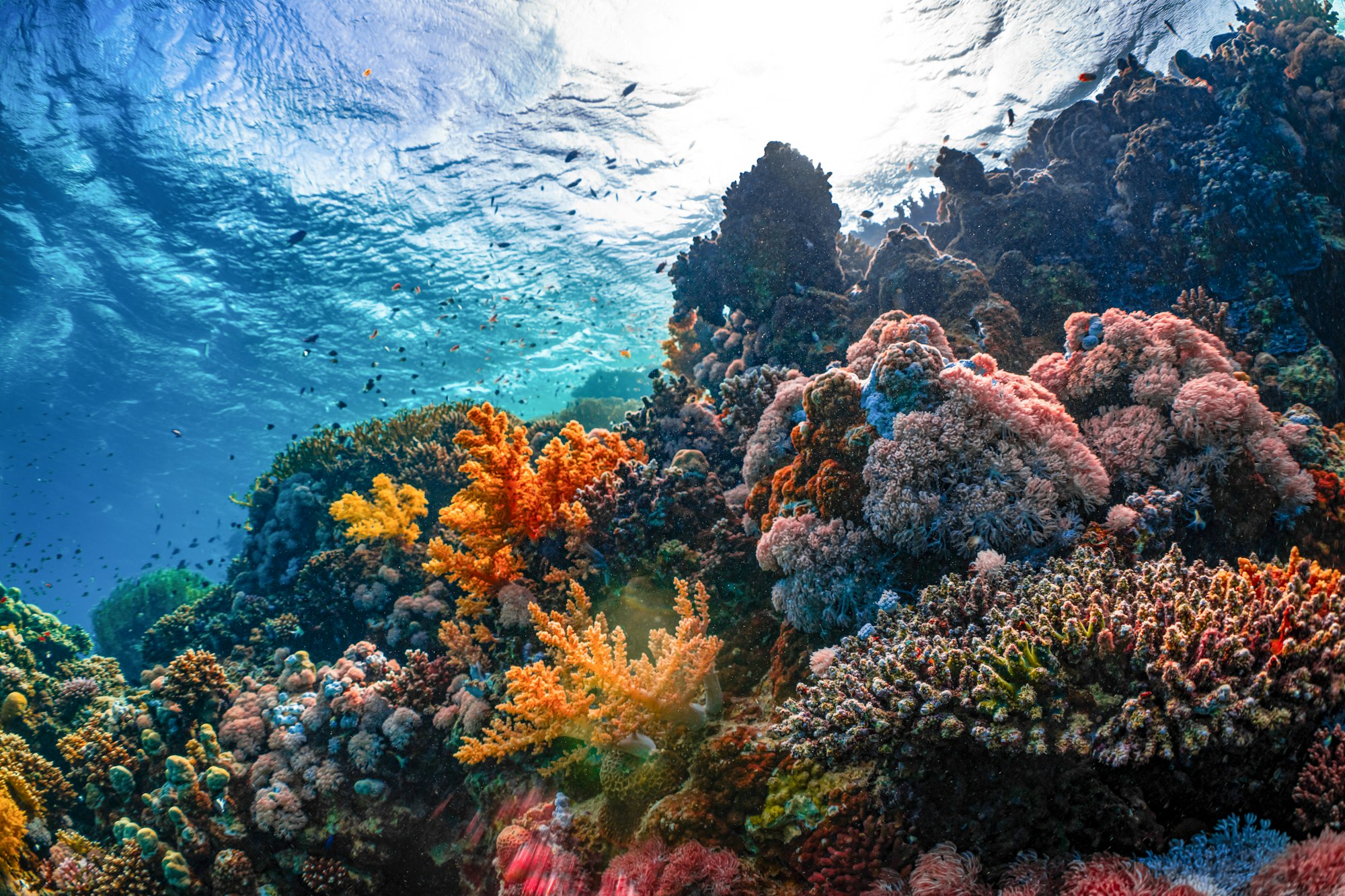
Bajo Alcyone
5.5090°N 87.0230°W · pinnacle
Cocos Island's legendary hammerhead seamount — a current-swept pinnacle rising to ~25m in open Pacific water, famed for vast schools of scalloped hammerheads circling its cleaning stations. Advanced, liveaboard-only.
Overview
Bajo Alcyone is the most celebrated dive site at Cocos Island (Isla del Coco), a UNESCO World Heritage national park roughly 550 kilometres off Costa Rica’s Pacific coast, reachable only by a liveaboard crossing of around 36 hours. The site is a submerged seamount whose summit rises to approximately 25 metres, its flanks dropping away into deep blue water. Named after Jacques Cousteau’s research vessel Alcyone, it is widely regarded as one of the finest big-animal dives on Earth.
Why divers come
The draw is hammerheads — scalloped hammerheads in numbers few other places on the planet can match. The seamount hosts cleaning stations where these sharks queue to have parasites removed by barberfish and angelfish, and on a good day divers watch dozens, sometimes hundreds, of hammerheads massing overhead in the current. It is the reason most divers endure the long crossing to Cocos.
The dive
Divers typically descend the mooring or drop straight onto the seamount’s summit around 25 metres, then find shelter behind rocks and ridges to stay out of the current and observe. Rather than chasing sharks — which pushes divers deeper and burns gas — the technique is to stay still, keep low, and let the hammerheads approach the cleaning stations. Reef hooks are not used at Cocos; divers hold position against the rock. The plateau and its edges are worked between roughly 25 and 40 metres, with the deeper blue kept in view for passing pelagics.
Marine life
Beyond the scalloped hammerhead schools, Bajo Alcyone regularly delivers silvertip and Galápagos sharks, whitetip reef sharks, large marble rays and passing mobulas, big schools of bigeye trevally and jacks, yellowfin tuna and green turtles. In the rainy season whale sharks are a possibility. Bait balls and hunting pelagics can turn the site into a feeding spectacle. Hammerheads, though iconic here, are wild animals and never guaranteed on any single dive.
Conditions & who should dive it
This is an advanced, current-swept, deep site in open ocean. Currents can be strong and shifting, thermoclines bring sudden cold water, and depths of 25–40 metres mean gas and no-deco limits must be managed carefully. Nitrox is strongly recommended and widely used. Cocos is not a destination for inexperienced divers: operators expect solid buoyancy, comfort in current and blue water, and a good number of logged dives. Good buoyancy also protects the cleaning-station behaviour that makes the site special.
When to go
Cocos dives year-round, and hammerheads are present in all seasons. The rainy season (roughly June to November) brings the largest hammerhead aggregations and the best chance of whale sharks, though with greener water, more surface chop and rain. The drier months (around December to May) generally offer calmer crossings and better visibility. Conditions vary and no season guarantees any particular animal.
Getting there
There is no accommodation on Cocos and day access is not possible — every dive is run from a liveaboard. Boats depart from Puntarenas on the Costa Rican mainland, and the open-ocean crossing takes around 32–36 hours each way, so trips are typically 10 days or longer. A national park fee applies and all diving is guided.
A note on protection
Cocos Island is a strictly protected UNESCO World Heritage Site and one of the world’s most important shark sanctuaries, with a large surrounding marine protected area. Illegal long-line fishing remains a threat to its hammerhead and silky shark populations. Divers should take nothing, touch nothing, maintain excellent buoyancy around the cleaning stations, and follow park and guide rules closely — the protection of this site is central to why its shark life endures.
Sea-surface temperature and wave height from Open-Meteo Marine (ERA5 reanalysis, monthly averages).
196806 verified species observations (57 species) logged within ~11 km of this site between 1932 and 2022, from the Ocean Biodiversity Information System.
- Chordata
- Elagatis bipinnulata
- Mammalia
- Actinopteri
- Lutjanus
- Cephalopholis
- Serranidae
- Kyphosus
- Trachinotus
- Melichthys niger
- Thalassoma lucasanum
- Cephalopholis colonus
Scientific survey records skew toward sampled taxa (molluscs, corals) and do not reflect what you are guaranteed to see on a dive.
Source: OBIS (obis.org), aggregated Darwin Core occurrence records.
Conditions change with the tide and the season. If you have dived this site, share what it was actually like — date, visibility, current, and what you saw. Real, recent reports from divers are exactly what this guide is built to collect.
Send a conditions report ›