Manuelita Outside
5.5628°N 87.0483°W · wall
An exposed outer-wall and drift dive off Manuelita Islet at Cocos, where scalloped hammerheads queue at cleaning stations amid Galápagos sharks and rays — an advanced, current-swept, liveaboard-only Eastern Pacific classic.
Overview
Manuelita Outside — also called Manuelita Deep — is the exposed, seaward face of Manuelita, a small islet off the northeast corner of Cocos Island (Isla del Coco). Cocos is a Costa Rican national park and UNESCO World Heritage Site sitting roughly 550 km (about 300 nautical miles) out in the open Eastern Pacific, reachable only by liveaboard after a 32-to-36-hour crossing from Puntarenas. Where the sheltered “Manuelita Inside” (Coral Garden) offers calm reef, the Outside is a deeper, current-swept wall built for big-animal encounters.
Why divers come
This is one of Cocos’s signature hammerhead sites. Steep, boulder-strewn slopes drop away seaward, and distinct cleaning stations draw a near-constant procession of scalloped hammerheads that hang in the current while barberfish pick them clean. Galápagos sharks, marble and eagle rays, and — reported since around 2007 — tiger sharks all patrol the same water, with whale sharks passing through in season. Few dives anywhere concentrate this much shark traffic in one place.
The dive
Boats deliver divers by panga to a negative entry. When current is running, the plan is a fast descent to the shelter of the large boulders, then holding position near the cleaning stations at roughly 21–24 m (70–80 ft) to watch hammerheads make slow approaches. The southern section is boulder terrain; the northern side steepens into a more vertical wall streaming with schooling razor surgeonfish, rainbow runners and creolefish. Depths beyond the stations fall past 30–35 m, so the profile is managed and often run as a drift along the reef edge.
Marine life
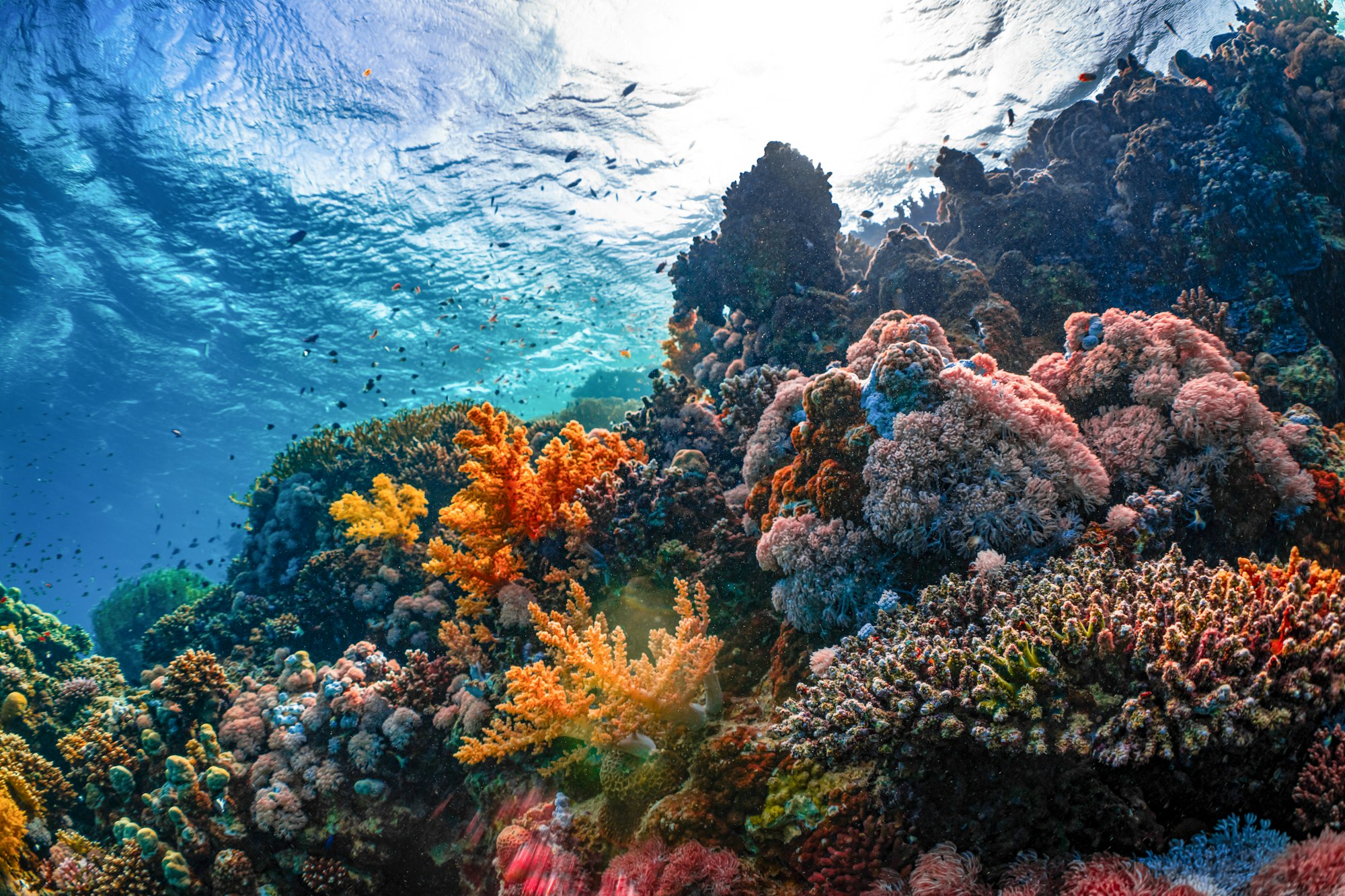
Scalloped hammerheads are the headline act, queuing at the stations. Galápagos sharks — among the larger species at Cocos — cruise the deeper blue, often several at once. Whitetip reef sharks are ubiquitous, tiger sharks are regular, and marble and eagle rays work the slope. Whale sharks and mantas are possible but not reliable. Reef fish, king angelfish and jack schools round out the scene. As with all wild shark diving, nothing is guaranteed on a given dive.
Conditions & who should dive it
This is an advanced dive. Currents can be strong and unpredictable, and there are documented cases of divers being swept off the wall into open water, so a reef hook, SMB and comfort with negative entries and blue-water drift are important. Visibility ranges widely (roughly 10–20 m, better in the dry season), and thermoclines can drop water temperature sharply below the 26–28°C surface layer — a 5 mm wetsuit or more is sensible. The nearest recompression chamber is on the mainland, well over a day away, so conservative profiles matter.
When to go
Cocos dives year-round by liveaboard, but the experience shifts with the season. The wetter June–November window (peak roughly August–September) brings green, plankton-rich water, rougher crossings and the strongest hammerhead and pelagic action, and is the better bet for whale sharks. The drier December–May season offers calmer seas and clearer water — sometimes 30 m-plus — but generally fewer hammerheads. June–July is often cited as a sweet spot balancing seas and big animals.
Getting there
There is no shore access and no day-boat option. Divers fly into San José, transfer to Puntarenas, and join a multi-day liveaboard for the ocean crossing; all diving is guided by park-authorised divemasters, and trips typically run 8–10 days or longer.
A note on protection
Cocos has been a marine national park since 1978 and a UNESCO World Heritage Site since 1997, with its surrounding waters part of a large protected seascape. Diver numbers, guides and behaviour are regulated — at cleaning stations that means staying back several metres and never swimming through an active station, which scatters the sharks and spoils the encounter for everyone.
Sea-surface temperature and wave height from Open-Meteo Marine (ERA5 reanalysis, monthly averages).
196861 verified species observations (58 species) logged within ~11 km of this site between 1932 and 2022, from the Ocean Biodiversity Information System.
- Chordata
- Elagatis bipinnulata
- Mammalia
- Actinopteri
- Lutjanus
- Cephalopholis
- Serranidae
- Kyphosus
- Trachinotus
- Melichthys niger
- Thalassoma lucasanum
- Cephalopholis colonus
Scientific survey records skew toward sampled taxa (molluscs, corals) and do not reflect what you are guaranteed to see on a dive.
Source: OBIS (obis.org), aggregated Darwin Core occurrence records.
Conditions change with the tide and the season. If you have dived this site, share what it was actually like — date, visibility, current, and what you saw. Real, recent reports from divers are exactly what this guide is built to collect.
Send a conditions report ›