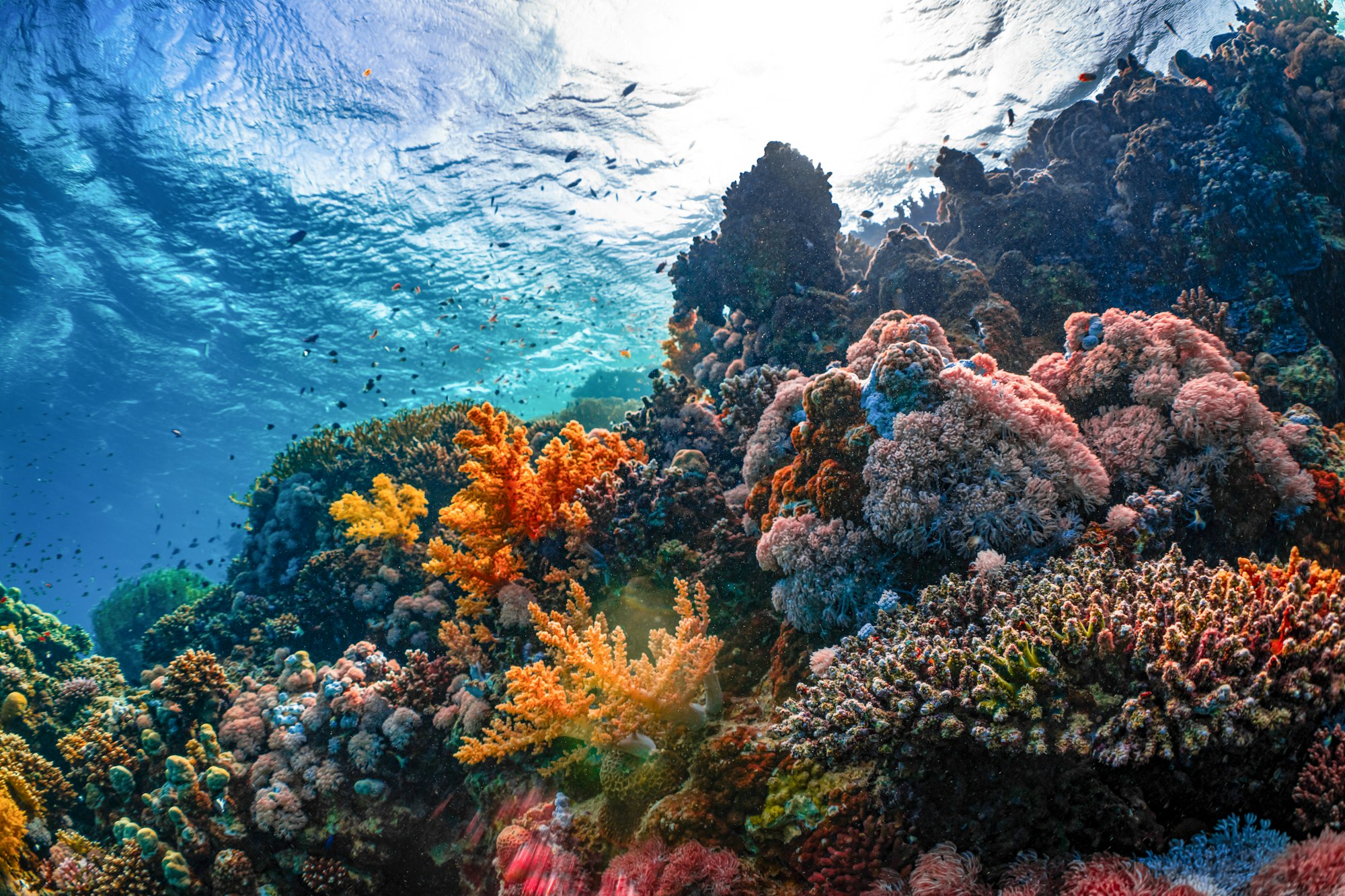
Punta Maria
5.5311°N 87.0912°W · pinnacle
A deep southwest-coast seamount off Cocos Island, Punta Maria is a spine of rock and pinnacles studded with cleaning stations where scalloped hammerheads and big Galápagos sharks pass close — an advanced, liveaboard-only dive.
Overview
Punta Maria is a submerged seamount lying roughly a third of a mile (about 500 m) off the southwest side of Cocos Island (Isla del Coco), the remote UNESCO World Heritage national park set some 340 miles (around 550 km) off Costa Rica’s Pacific coast. The site is a long spine of rock — a crown at roughly 25 m surrounded by deeper sloping walls, with a couple of pinnacles rising to about 20 m (65 ft) to the north. There is no shallow refuge here, which sets the tone for the whole dive.
Why divers come
Like the marquee sites of Cocos — Bajo Alcyone and Dirty Rock — Punta Maria is prized as hammerhead country. Its rock is dotted with cleaning stations, and a central sand channel gives divers a place to tuck in and watch. When conditions align, scalloped hammerheads school overhead while large Galápagos sharks make close, curious passes. It is regularly listed among the best areas at Cocos for concentrated shark action.
The dive
Divers typically descend by shot line or mooring line onto the shallower side of the ridge, then peer over the top toward the blue. Because the site starts deep — no section is shallower than about 18–20 m — teams often drop to 27–30 m or more, settling against rock to shelter from current and watch the cleaning stations. Reef hooks, good buoyancy and disciplined gas and no-decompression management are essential; nitrox is strongly recommended to claw back bottom time that vanishes quickly at these depths.
Marine life
The headline animals are scalloped hammerheads at the cleaner stations and big Galápagos sharks, some reported past 3 m. Whitetip reef sharks, silky sharks, marble rays, eagle rays, moray eels and dense schools of jacks and snapper round out the cast. Larger pelagics — including whale sharks and mobula/manta rays — pass through Cocos seasonally, but they are never guaranteed at any single site; treat any encounter as a bonus rather than an expectation. Punta Maria sits in the same southwest sector as the Dos Amigos rocks and their arches; sources describe them as separate dives rather than one connected site.
Conditions & who should dive it
This is honestly an advanced dive. Current can rush over the seamount, sometimes forcing a fast descent down the line to depth, and thermoclines bring sudden cold water typical of Cocos. Combined with its depth and lack of any shallow escape, Punta Maria suits experienced divers comfortable in strong current, cold thermoclines and deep profiles. Newer divers should build experience on Cocos’s gentler sites first.
When to go
Cocos is a year-round liveaboard destination. The rainier June–November window is generally associated with the strongest hammerhead schooling and the better odds of whale sharks, while the drier December–May months tend to bring calmer surface conditions and clearer water — with more surge as a trade-off. Operators dive Punta Maria only when current permits, so exact scheduling is at the crew’s discretion.
Getting there
There is no day-tripping to Cocos. The island is reachable only by liveaboard, on trips of roughly 10 days or more departing Puntarenas on mainland Costa Rica, with about 32–36 hours of open-ocean crossing each way. Only a small number of vessels hold permits to dive the national park.
A note on protection
Cocos Island National Park and its surrounding marine reserve are strictly protected, with park fees, ranger oversight and rules on where and how boats may operate. Divers help by staying off the reef, keeping a respectful distance from sharks and rays at cleaning stations, and following crew guidance — the very abundance that draws people here depends on that protection holding.
Sea-surface temperature and wave height from Open-Meteo Marine (ERA5 reanalysis, monthly averages).
196735 verified species observations (58 species) logged within ~11 km of this site between 1932 and 2022, from the Ocean Biodiversity Information System.
- Chordata
- Elagatis bipinnulata
- Mammalia
- Actinopteri
- Lutjanus
- Cephalopholis
- Serranidae
- Kyphosus
- Trachinotus
- Melichthys niger
- Thalassoma lucasanum
- Cephalopholis colonus
Scientific survey records skew toward sampled taxa (molluscs, corals) and do not reflect what you are guaranteed to see on a dive.
Source: OBIS (obis.org), aggregated Darwin Core occurrence records.
Conditions change with the tide and the season. If you have dived this site, share what it was actually like — date, visibility, current, and what you saw. Real, recent reports from divers are exactly what this guide is built to collect.
Send a conditions report ›