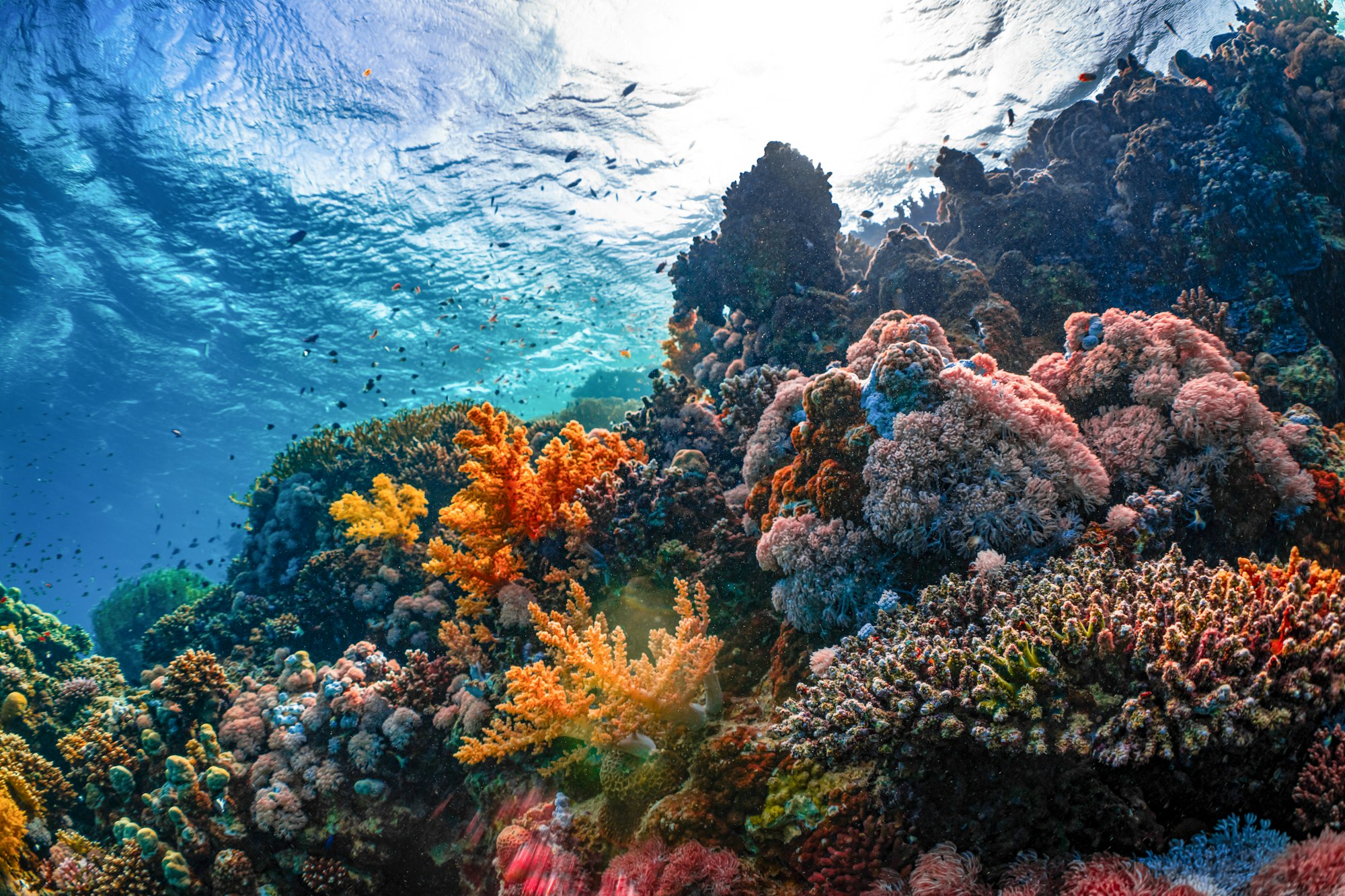
Dirty Rock
5.5450°N 87.0852°W · pinnacle
An iconic guano-streaked rock cluster off Cocos Island's northwest coast, Dirty Rock draws divers with cleaning-station-fed schools of scalloped hammerheads; a strong-current, deep pelagic dive for advanced liveaboard travellers only.
Overview
Dirty Rock sits off the northwest corner of Cocos Island (Isla del Coco), a UNESCO World Heritage national park roughly 550 km southwest of mainland Costa Rica and reachable only by liveaboard after a crossing of about 36 hours. The site is a cluster of rocky pinnacles breaking the surface — its brown-and-white streaking, and its name, come from generations of seabirds nesting and guano-bombing the exposed rock. Below the waterline those rocks drop into blue water and a series of cleaning stations that make this one of Cocos’s busiest and most celebrated shark dives.
Why divers come
This is a hammerhead dive above almost all else. Dirty Rock is world-renowned as one of the few places on the planet where scalloped hammerheads reliably gather in large schools, cruising in from the blue to be groomed at the site’s cleaning stations. On a good day the water fills with hammerheads while Galápagos sharks, marble and eagle rays, turtles and a wall of bigeye jacks crowd the same reef — a density of big animals that rewards the long ocean crossing.
The dive
Divers typically descend along the rocks toward a main viewing area around 27–30 m, where cleaning stations run along the southern face and a small marker buoy gives a reference point. The proven technique is to settle low against the rock, stay still and calm, control bubbles, and let the sharks approach rather than chase them. From the hammerhead station the profile continues toward the island’s pinnacle, past a small cave holding lobsters and further turtle and ray cleaning stations. Depths span roughly 6 m near the top to the mid-30s deeper down, so gas planning and no-deco discipline matter.
Marine life
The headline is schooling scalloped hammerheads, but Dirty Rock is genuinely multi-species: Galápagos and whitetip reef sharks, marble rays, eagle rays, green turtles, octopus, and dense schools of bigeye jacks and other reef fish. Bottlenose dolphins occasionally work the site. Whale sharks pass through seasonally but are never guaranteed — treat any sighting as a bonus, not an expectation.
Conditions & who should dive it
Sitting well offshore, Dirty Rock is exposed to strong, sometimes surging currents, and cold thermoclines can slice through the deeper water. This is squarely an advanced, current-experienced dive: divers are expected to hold position in current, manage a deep profile, and often shelter behind rocks between shark passes. Most operators require Advanced Open Water certification and a solid number of logged dives; it is not a site for the newly certified. A reef hook or good negative-buoyancy skills and calm air consumption go a long way here.
When to go
Cocos dives year-round, but the seasons trade off honestly. The wet season, roughly June to November, brings the biggest hammerhead aggregations along with rougher crossings, stronger current and lower visibility (often around 10–20 m); late wet season, about August to October, is the better window for whale sharks. The dry season, December to May, offers calmer seas and clearer water (20–30 m) but generally fewer sharks. Water sits around 24–28°C, colder in the thermoclines.
Getting there
There is no accommodation on Cocos and no day access — every dive is run from a liveaboard. Boats depart Puntarenas on Costa Rica’s Pacific coast, and the open-ocean crossing takes around 36 hours each way, so trips typically run 10 days or longer. A national park fee applies and all diving is guided.
A note on protection
Cocos Island National Park is a fully protected marine reserve and shark sanctuary, and its scalloped hammerhead populations are of serious conservation concern regionally. Diving is tightly regulated by park rangers; follow briefings, keep your distance from cleaning stations, and never touch or crowd the animals — the schooling behaviour that makes Dirty Rock extraordinary depends on divers behaving as quiet guests.
Sea-surface temperature and wave height from Open-Meteo Marine (ERA5 reanalysis, monthly averages).
196792 verified species observations (58 species) logged within ~11 km of this site between 1932 and 2022, from the Ocean Biodiversity Information System.
- Chordata
- Elagatis bipinnulata
- Mammalia
- Actinopteri
- Lutjanus
- Cephalopholis
- Serranidae
- Kyphosus
- Trachinotus
- Melichthys niger
- Thalassoma lucasanum
- Cephalopholis colonus
Scientific survey records skew toward sampled taxa (molluscs, corals) and do not reflect what you are guaranteed to see on a dive.
Source: OBIS (obis.org), aggregated Darwin Core occurrence records.
Conditions change with the tide and the season. If you have dived this site, share what it was actually like — date, visibility, current, and what you saw. Real, recent reports from divers are exactly what this guide is built to collect.
Send a conditions report ›