Cabo Pearce
18.7300°N 110.9500°W · wall
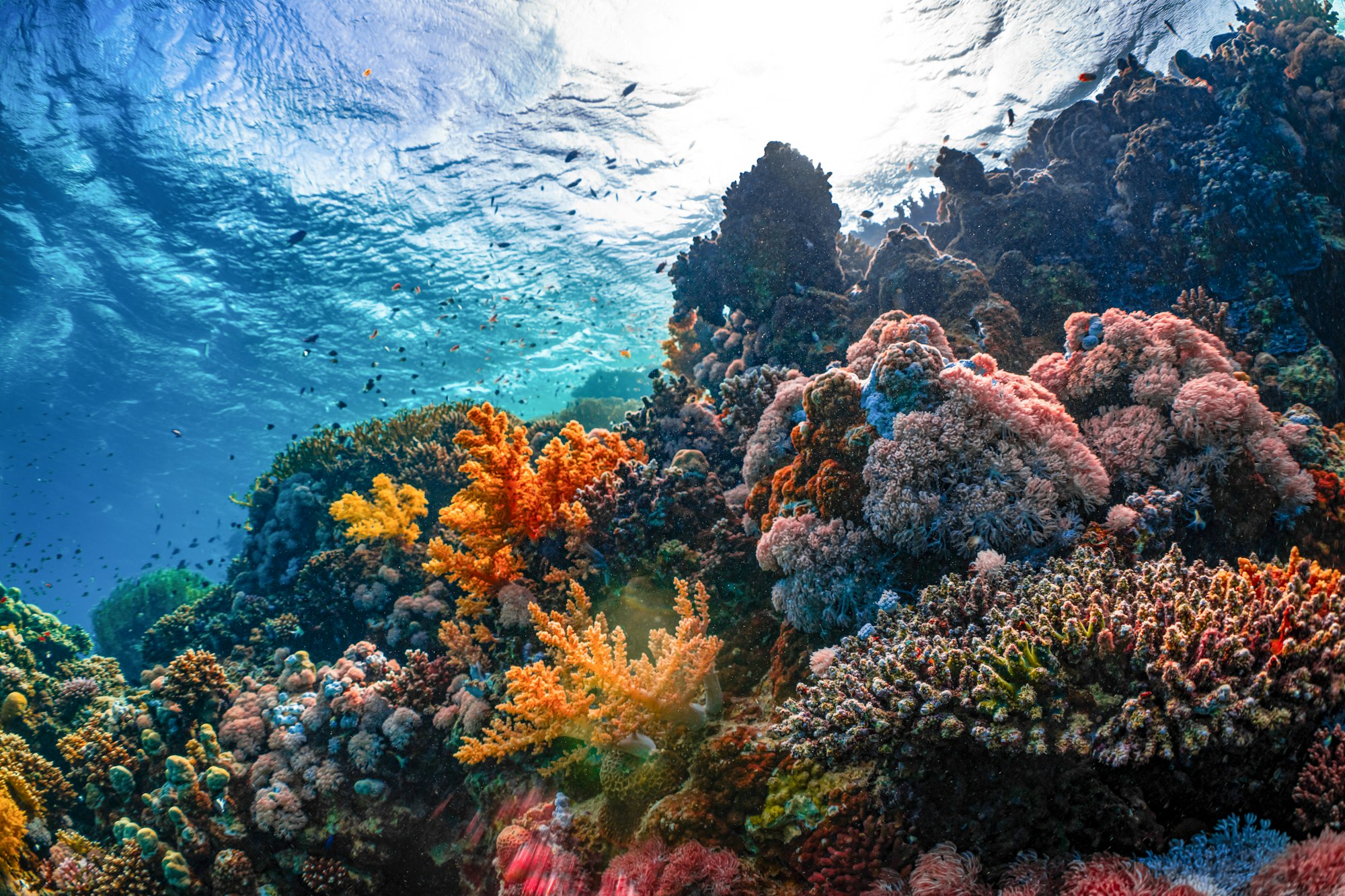
A long volcanic ridge running seaward off Socorro's east coast, Cabo Pearce is one of Revillagigedo's premier manta cleaning stations, famous for giant oceanic mantas and near-daily bottlenose dolphin encounters — an advanced, liveaboard-only drift dive.
Overview
Cabo Pearce sits on the eastern side of Socorro Island, the largest of the four volcanic islands that make up Mexico’s Revillagigedo Archipelago, roughly 390–400 km south-southeast of Cabo San Lucas. The site is a long, finger-like ridge of volcanic rock that runs out from the shoreline and drops away into open ocean — a natural pinnacle of structure planted in blue water, which is precisely why the big animals use it.
The archipelago was inscribed on the UNESCO World Heritage List in 2016 and declared a Mexican national park and marine reserve the following year. There is no accommodation ashore and no shore access without a permit: every dive here is made from a licensed liveaboard.
Why divers come
Two things, above all. Cabo Pearce hosts one of Socorro’s most reliable manta cleaning stations, where giant oceanic mantas hang in the current while small reef fish work over their skin and gills. Socorro’s mantas are unusual in their apparent tolerance of — and reported curiosity toward — divers, often circling repeatedly through exhaled bubbles.
Second, the bottlenose dolphins. Dive media note that dolphins visit sites such as Cabo Pearce almost daily, with long encounters a frequent occurrence. They are wild animals and nothing is promised, but few sites anywhere have a comparable reputation for genuinely interactive dolphin behaviour underwater.
The dive
Divers are dropped along the ridge and work it as a drift. Recreational profiles here typically top out around 30 m; the ridge itself continues far deeper into the blue. A common approach is to go deeper early — scanning open water for passing sharks — then work slowly up and along the structure, spending the bulk of bottom time near the cleaning stations in shallower water.
The ridge doubles as shelter. When current runs hard along its length, guides tuck groups into the lee of the rock or between boulders, letting the animals come to them rather than swimming into flow. Visibility is commonly in the 15–25 m range, though it varies with plankton and swell.
Marine life
Beyond mantas and dolphins, Cabo Pearce draws scalloped hammerheads — sometimes schooling, sometimes deep and passing — along with Galapagos and silky sharks patrolling the blue, plus dense schools of jacks and tuna. Whale sharks are a seasonal possibility across the archipelago rather than a Cabo Pearce speciality, and humpback whales are present in the region in winter, more often heard through the water than seen.
Conditions & who should dive it
This is an advanced site. Currents range from near-slack to roughly two knots, with surge, swell and blue-water safety stops all in play. PADI lists Advanced Open Water as the recommended certification; several operators additionally recommend nitrox, and some liveaboards set their own minimum logged-dive requirements — check before booking. Solid buoyancy, comfort with negative or backward-roll entries, SMB competence and the discipline to stay with a guide in current are the real prerequisites. Park rules commonly enforced include a maximum recreational depth around 35 m, no decompression diving and no night diving.
Water temperatures run roughly 21 °C in winter to the high 20s in summer — a 5 mm suit or thicker suits most divers in the main season.
When to go
The season runs approximately November through May, with some operators extending into June or mid-July before the park effectively closes for the storm months into October. Cooler months (January–March) bring humpbacks and, many operators report, strong manta activity; the shoulder months trend warmer. No month guarantees any given animal.
Getting there
Liveaboards depart Cabo San Lucas or San José del Cabo. The open-ocean crossing takes roughly 24 hours each way, and trips typically run 8–10 nights. There is no day-boat or land-based option.
A note on protection
Revillagigedo is a fully protected marine reserve with fishing banned within 12 nautical miles of each island. Standard practice — and in places regulation — is to never touch or chase mantas, dolphins or sharks, to avoid blocking a manta’s path to a cleaning station, and to keep bubbles clear of animals directly overhead. The mantas’ apparent trust here is the site’s rarest asset; it depends on divers behaving well.
- Cabo Pierce dive site — PADI
- Best Dive Sites in Socorro: Oceanic Mantas & Sharks — Nautilus Liveaboards
- Socorro Diving (Revillagigedo): Best Time to Go, Giant Mantas, Sharks & Liveaboards — Bluewater Dive Travel
- Scuba Diving Mexico | Revillagigedo & Guadalupe — DIVE Magazine
- Archipiélago de Revillagigedo — UNESCO World Heritage Centre
Sea-surface temperature and wave height from Open-Meteo Marine (ERA5 reanalysis, monthly averages).
16011 verified species observations (104 species) logged within ~11 km of this site between 1897 and 2023, from the Ocean Biodiversity Information System.
- Chordata
- Megaptera novaeangliae · Humpback whale
- Mammalia
- Actinopteri
- Kuhlia mugil
- Myripristis clarionensis
- Entomacrodus chiostictus
- Thunnus
- Euleptorhamphus viridis
- Mugil curema
- Scorpaenodes xyris
- Thalassoma lucasanum
Scientific survey records skew toward sampled taxa (molluscs, corals) and do not reflect what you are guaranteed to see on a dive.
Source: OBIS (obis.org), aggregated Darwin Core occurrence records.
Conditions change with the tide and the season. If you have dived this site, share what it was actually like — date, visibility, current, and what you saw. Real, recent reports from divers are exactly what this guide is built to collect.
Send a conditions report ›