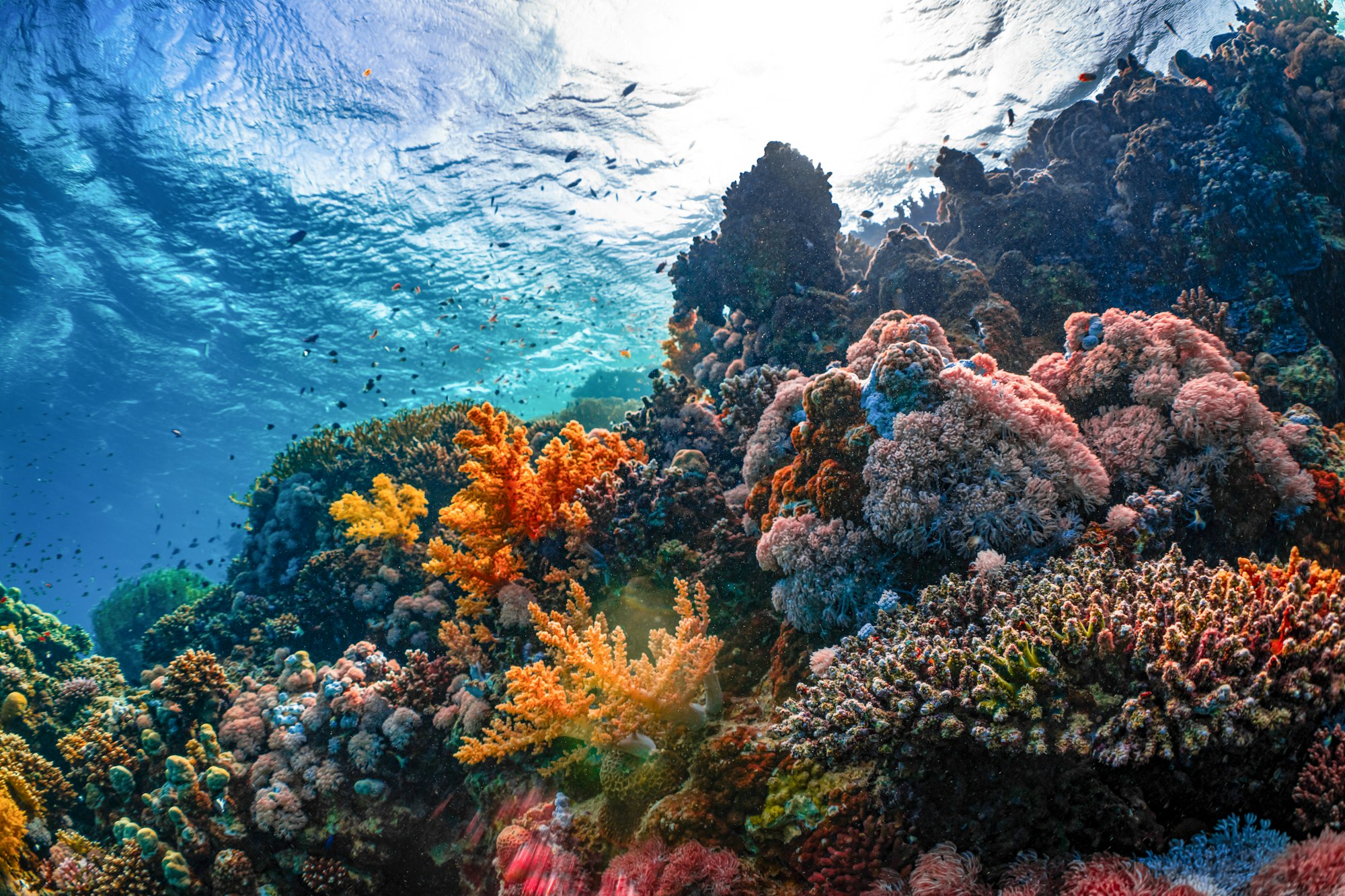
Roca Partida
19.0000°N 112.0667°W · pinnacle
A bare volcanic spire in the open Pacific, Roca Partida is the Revillagigedo Archipelago's most dramatic dive: sheer walls dropping into the abyss, ledges stacked with resting whitetip reef sharks, and passing pelagics. Advanced, liveaboard-only diving.
Overview
Roca Partida is the smallest and most remote of the four islands that make up Mexico’s Revillagigedo Archipelago, the group divers usually call Socorro. It lies roughly 390–400 km south of the tip of Baja California, and Roca Partida itself sits well west of Socorro Island — a bare, guano-white volcanic spire only a few hundred metres long and around 30 m high, with no beach, no vegetation and no shelter. Below the waterline it becomes something else entirely: near-vertical walls that fall away from the rock into open blue, standing on a flat-topped seamount that drops far past any recreational limit toward abyssal depths. The archipelago was inscribed on the UNESCO World Heritage List in 2016, and in November 2017 Mexico declared the surrounding waters a national park and no-take marine protected area.
Why divers come
Roca Partida is the site people book a Socorro trip for. It concentrates open-ocean life onto a single rock in a way few places do: the wall’s ledges and undercuts hold famous “cuddle puddles” of whitetip reef sharks resting stacked on top of one another like cordwood, while the blue water off the corners can produce schooling hammerheads, Galápagos, silvertip and silky sharks, dolphins, tuna and oceanic mantas. Because the rock is small, a single dive can circle it more than once, and each lap can look different.
The dive
Boats drop divers on whichever side is sheltered that day and the group works the wall, typically holding somewhere around 20–25 m and cruising the ledges before drifting off a corner to watch open water. There is no reef, no sand flat and no shallow refuge — the profile is a wall dive from start to finish, and the safety stop is done in blue water, often with the group on an SMB. Depth discipline matters here more than almost anywhere: the bottom offers no visual stop, and the temptation to chase animals downward is constant. Most operators run conservative computer-driven profiles, and nitrox is standard.
Marine life
Whitetip reef sharks are the reliable resident attraction, along with Pacific creolefish clouding the upper water column, jacks and yellowfin tuna. Hammerheads, Galápagos and silvertip sharks are frequent but never guaranteed; the same is true of the oceanic mantas that made Socorro famous, which are more consistently encountered at San Benedicto’s cleaning stations than here. Whale sharks and humpback whales are seasonal bonuses — humpbacks pass through roughly February to April, and their song is often audible underwater even when no whale is seen.
Conditions & who should dive it
This is advanced open-ocean diving. Currents can be strong and change through a dive, surge works the shallows, and down-currents are a documented hazard on exposed Pacific pinnacles like this one. Visibility is often excellent but variable. Most liveaboards require an Advanced Open Water certification (or equivalent) and a minimum of around 50 logged dives; comfort with blue-water descents, negative entries, SMB deployment and drifting away from any reference is more important than the card itself. Water temperatures run roughly 21–23°C in the cooler months and 24–27°C early season, so a 5 mm or 7 mm suit is normal. If weather deteriorates there is nowhere to hide at Roca Partida, and captains will move the ship — schedule changes are part of the trip.
When to go
The season runs approximately November to May or June, dictated by open-Pacific weather. November–December brings the warmest water and better whale shark odds; January–April is peak humpback season; late season tends toward cooler, more nutrient-rich water and heavier shark and bait-ball activity.
Getting there
Liveaboard only. Trips leave from Cabo San Lucas or San José del Cabo and take roughly 24–30 hours of open-ocean crossing each way, so itineraries are typically 8–9 days for 5–6 diving days. There is no day-boat or shore-based option, and no landing on the rock.
A note on protection
Revillagigedo National Park is a no-take marine reserve with limited permitted access; liveaboards operate under permit and guests pay a park fee on top of the trip price. No touching, no gloves in most operations, no chasing animals, and no riding or blocking mantas — the fee and the rules are what keep the rock this crowded with sharks.
- Iconic Dive Site: Roca Partida, Revillagigedo, Mexico — DivePhotoGuide
- Scuba Diving Mexico: Revillagigedo Archipelago & Guadalupe Island — DIVE Magazine
- The Best Dive Sites in Socorro — Nautilus Liveaboards
- Socorro Diving (Revillagigedo): Best Time to Go, Giant Mantas, Sharks & Liveaboards — Bluewater Dive Travel
- Revillagigedo Islands — Wikipedia
Sea-surface temperature and wave height from Open-Meteo Marine (ERA5 reanalysis, monthly averages).
11081 verified species observations (59 species) logged within ~11 km of this site between 1925 and 2023, from the Ocean Biodiversity Information System.
- Chordata
- Mammalia
- Thunnus
- Scombridae
- Actinopteri
- Phosichthyidae
- Carcharhinus falciformis
- Diogenichthys laternatus
- Elagatis bipinnulata
- Vinciguerria lucetia
- Entomacrodus chiostictus
- Scuticaria tigrina
Scientific survey records skew toward sampled taxa (molluscs, corals) and do not reflect what you are guaranteed to see on a dive.
Source: OBIS (obis.org), aggregated Darwin Core occurrence records.
Conditions change with the tide and the season. If you have dived this site, share what it was actually like — date, visibility, current, and what you saw. Real, recent reports from divers are exactly what this guide is built to collect.
Send a conditions report ›