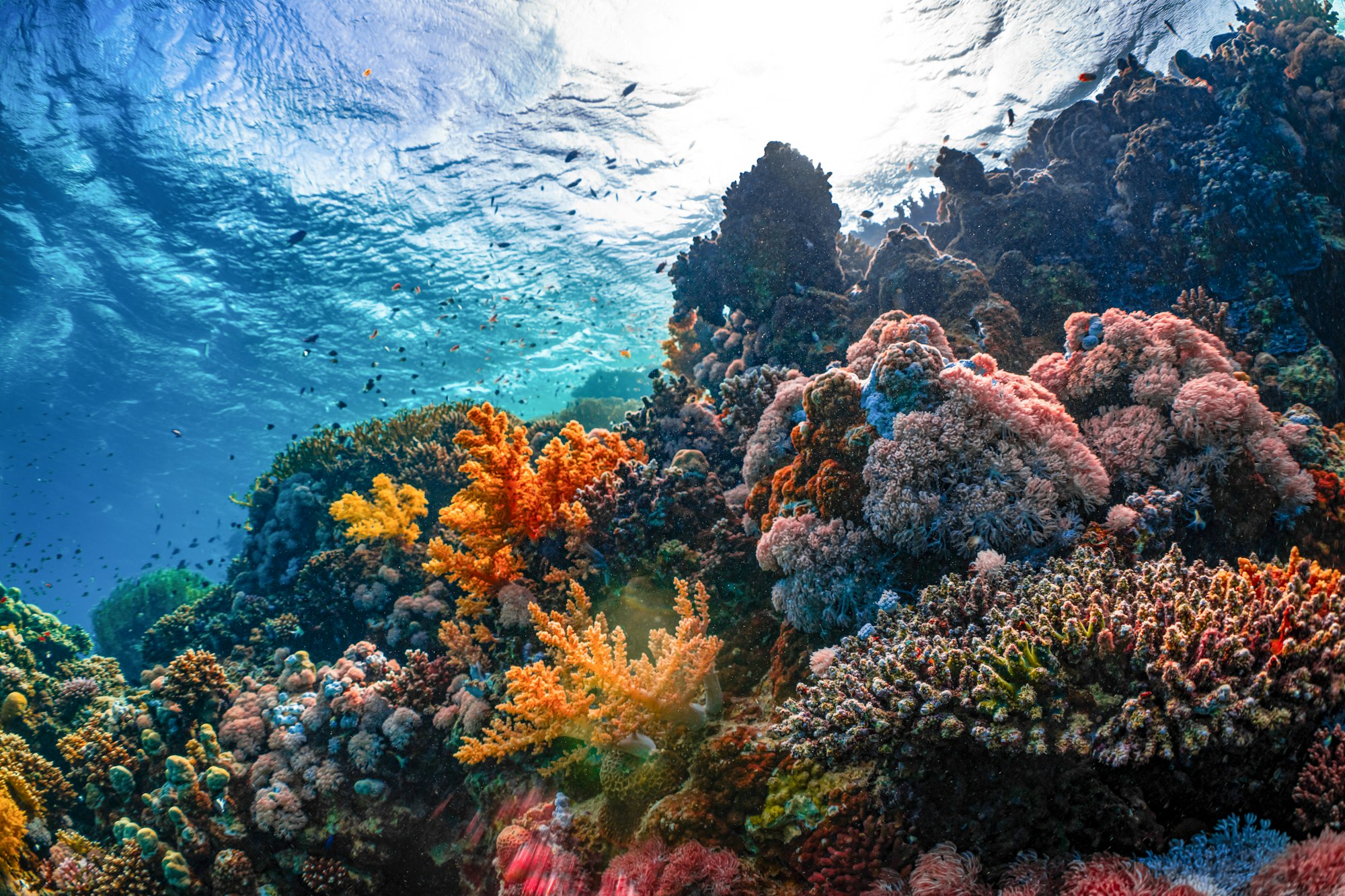
Punta Tosca
18.7100°N 110.9800°W · wall
The rocky point at Socorro Island's western end, where lava fingers, boulder fields and a shallow plateau draw oceanic mantas, bottlenose dolphins and a wide shark cast — an advanced, current-swept, liveaboard-only dive.
Overview
Punta Tosca is the exposed rocky point at the western end of Socorro Island, the largest island in Mexico’s Revillagigedo Archipelago. Operators consistently place it on Socorro’s west coast, where the volcanic shoreline drops away into a submerged landscape of lava fingers, boulder fields and sand channels. It is one of the archipelago’s regular stops on a liveaboard rotation that also takes in San Benedicto’s Boiler and the offshore pinnacle of Roca Partida.
Worth saying plainly: Punta Tosca is less exhaustively documented than those two headline sites. Operator write-ups agree on its character but rarely publish depth profiles or current ratings for it specifically. What follows sticks to what multiple independent sources describe consistently.
Why divers come
Two things recur in every account. The first is topography — Dive The World calls it one of the few genuinely photogenic pieces of terrain in an archipelago better known for blue water than scenery, and Nautilus describes it as the most colourful corner of the islands, with more coral growth than neighbouring sites. The second is dolphins. Punta Tosca has a strong reputation for prolonged, curious bottlenose dolphin encounters, with operators rating it the best site in the group for them.
Beyond that it is a broad-spectrum big-animal site rather than a single-species one: oceanic mantas, a rotating cast of sharks, and seasonal humpback whales.
The dive
Divers typically work a plateau in the shallow range — Dive The World puts it around 10–12 m — which holds smaller reef life, lobsters and moray eels, and which gives way to a cavern feature. From there the terrain runs out as a series of lava ridges and boulder slopes into deeper water and sand. Much of the diving is spent drifting between these ridges, tucking in behind rock to watch the blue, or hovering mid-water along the edge of the drop.
Depths are diver-managed rather than fixed. Most of the site’s value is in the 15–30 m band, but the deeper terrain makes it easy to sink further while distracted — one published firsthand account records hitting well past 35 m without noticing. Conservative gas planning and a disciplined depth alarm matter here.
Marine life
Oceanic mantas pass through, though Punta Tosca is not the archipelago’s most reliable manta station. Sharks are the broader draw: silvertips, Galapagos and silky sharks are commonly listed, tiger sharks are reported here more often than at most Socorro sites, and hammerheads appear in some operator accounts as an occasional rather than dependable sighting. Bottlenose dolphins are the signature. Humpback whales are heard and sometimes seen during the winter months. Reef-scale life includes Panamic green morays, giant hawkfish, Moorish idols, pufferfish, turtles and lobsters.
Conditions & who should dive it
This is an advanced dive. Socorro diving in general involves current, surge and open-ocean exposure, and Punta Tosca’s position on an exposed point means divers should expect current strong enough to require holding onto rock to stay in place while animals pass. Negative entries, SMB competence, comfortable air consumption and experience in moving water are practical prerequisites; operators generally expect an Advanced certification and a solid recent logbook. Water sits roughly 21–27°C depending on the month, cooler in midwinter.
When to go
The season runs approximately November to May, with some operators extending into June. Late January to early April is the humpback window and the coolest water; the shoulder months at either end tend to be warmer and are favoured for manta and shark activity.
Getting there
Liveaboard only — there is no tourist accommodation on the islands. Boats depart Cabo San Lucas or San José del Cabo for a crossing of roughly 24–30 hours to reach the archipelago, which lies over 390 km southwest of Cabo San Lucas.
A note on protection
The Revillagigedo Archipelago was inscribed as a UNESCO World Heritage Site in 2016 and declared a Mexican national park and marine reserve in November 2017, creating one of the largest fully protected marine areas in North America. Access is permit-controlled, fishing is prohibited, and park fees are normally bundled into liveaboard pricing. Standard park rules — no touching, no chasing, no gloves — apply, and they are the reason the animals here still behave as they do.
- Diving in Socorro: Epic Manta Rays & Shark Encounters — Dive The World
- The Best Dive Sites in Socorro — Nautilus Liveaboards
- Diving the Revillagigedoes: Punta Tosca — Travels with Tam
- Socorro Diving (Revillagigedo): Best Time to Go, Giant Mantas, Sharks & Liveaboards — Bluewater Dive Travel
- Scuba Diving Socorro: Your Complete Guide — Nautilus Liveaboards
Sea-surface temperature and wave height from Open-Meteo Marine (ERA5 reanalysis, monthly averages).
15899 verified species observations (98 species) logged within ~11 km of this site between 1897 and 2023, from the Ocean Biodiversity Information System.
- Chordata
- Megaptera novaeangliae · Humpback whale
- Mammalia
- Actinopteri
- Kuhlia mugil
- Myripristis clarionensis
- Entomacrodus chiostictus
- Thunnus
- Euleptorhamphus viridis
- Mugil curema
- Thalassoma lucasanum
- Acanthocybium solandri
Scientific survey records skew toward sampled taxa (molluscs, corals) and do not reflect what you are guaranteed to see on a dive.
Source: OBIS (obis.org), aggregated Darwin Core occurrence records.
Conditions change with the tide and the season. If you have dived this site, share what it was actually like — date, visibility, current, and what you saw. Real, recent reports from divers are exactly what this guide is built to collect.
Send a conditions report ›