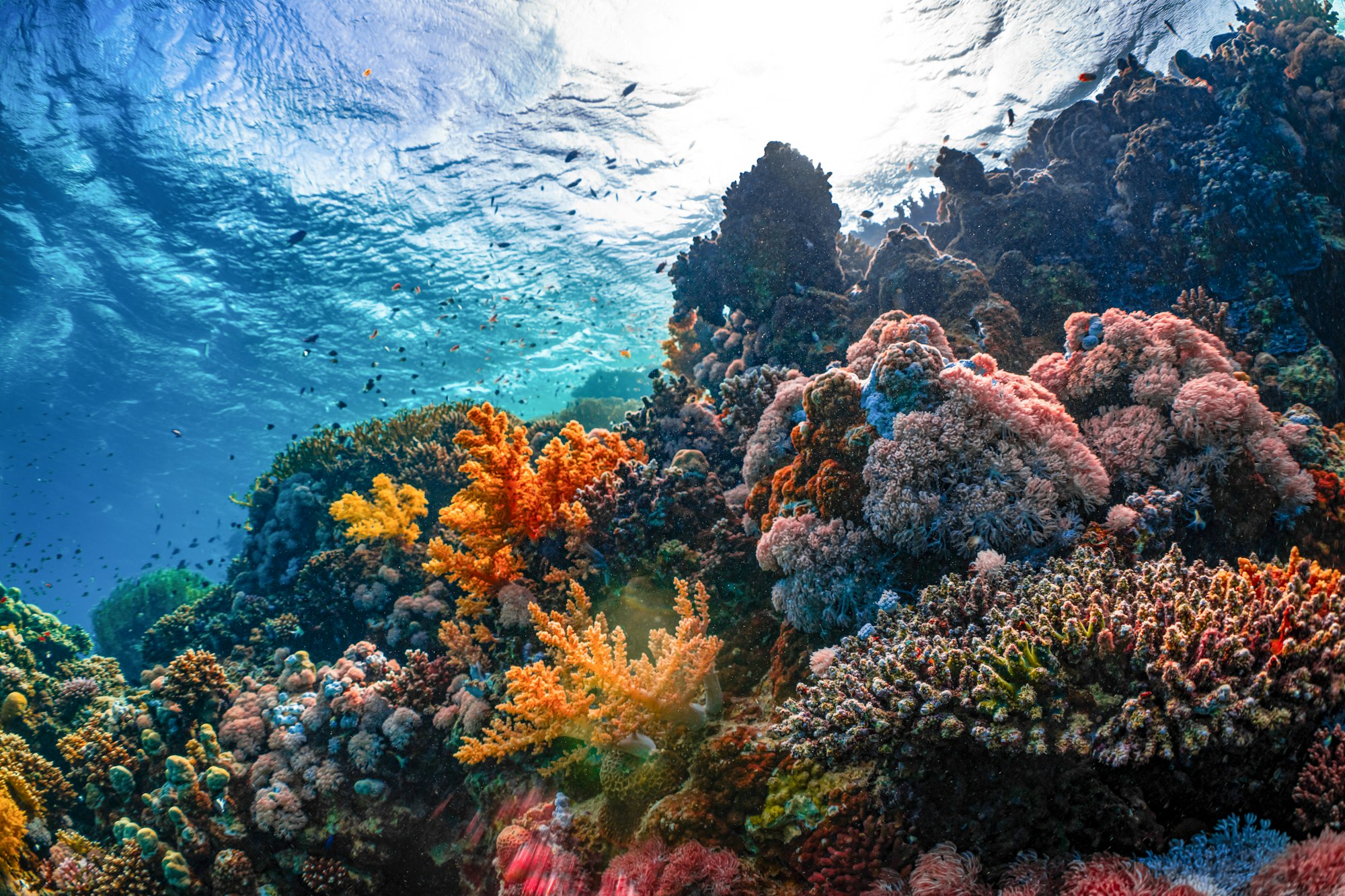
San Benedicto Canyon
19.3167°N 110.8167°W · wall
A sloping lava ridge and cleaning station complex off the south side of San Benedicto, The Canyon is Socorro's signature shark dive — silvertips, Galápagos and schooling scalloped hammerheads in blue water, for advanced liveaboard divers.
Overview
The Canyon — El Cañón to the crews who dive it — lies off the southern end of San Benedicto, the northernmost of the four islands making up Mexico’s Revillagigedo Archipelago. The archipelago sits roughly 390 km southwest of the tip of the Baja California peninsula, far enough offshore that every dive here is reached by liveaboard after an open-Pacific crossing. San Benedicto is a bare volcanic cone, and The Canyon is its underwater extension: a sloping ridge of lava rock running seaward from the island, cut with jagged points and gullies that give the site its name, dropping away toward deep blue water on either side.
Why divers come
San Benedicto’s other famous site, The Boiler, is the manta pilgrimage. The Canyon is the shark dive. Operators consistently describe it as the archipelago’s most reliable place to see multiple shark species in a single dive — silvertips, Galápagos, silkies and whitetip reef sharks working the site’s cleaning stations, with scalloped hammerheads passing through, sometimes in large schools. Giant oceanic mantas turn up here too, though encounters are generally less intimate than at The Boiler.
The dive
Divers are dropped from skiffs at the top of the slope and follow the rock down, weaving through the broken terrain to the cleaning-station area. Most operators work the site in roughly the 20–30 m band, where the reported maximum for a typical recreational profile is around 27–30 m; the structure itself continues into much deeper water beyond the sand and rubble patches. The usual technique is to settle low behind the rock, stay still, keep bubbles to a minimum and let the animals come in over the cleaning station. Nitrox and a computer-managed profile are the norm, and time at depth is the limiting factor.
Marine life
Sharks dominate. Galápagos and silvertips are the most habitual visitors to the cleaning stations, silkies tend to hang mid-water and in the blue near the boat, and whitetip reef sharks rest on the rock. Scalloped hammerheads are the headline draw, appearing as singles, small groups or — when conditions align — in schools. Tiger sharks are reported occasionally rather than routinely. Away from the sharks, expect clouds of reef fish along the slope, jacks and yellowfin tuna in the current line, dolphins that sometimes come in to interact, and, in winter, the possibility of hearing humpback whales.
Conditions & who should dive it
This is an advanced site. Currents can be strong and variable, surge is common on the shallow rock, and everything happens in open ocean with abyssal depths nearby. That said, several operators note The Canyon is often less exposed than The Boiler and becomes the fallback when surface conditions there deteriorate. Divers should be comfortable with negative entries, blue-water descents, drift technique, an SMB and skiff pickups. Water temperature across the season runs roughly 21–27°C, so a 5 mm or 7 mm suit is standard.
When to go
The liveaboard season runs approximately November to May or June. Shark activity — including hammerhead schooling — is generally reported as strongest in the cooler-water months, with sources variously favouring November to early January and January through April; early-morning dives are widely regarded as the best odds. None of this is a guarantee. Hammerhead schools at The Canyon are seasonal and genuinely variable, and a week here can deliver hundreds of sharks or a handful.
Getting there
Access is liveaboard-only, with most vessels departing Cabo San Lucas and a smaller number from San José del Cabo or mainland ports. The crossing to San Benedicto typically takes 24–30 hours each way, and trips generally run eight to twelve days to cover San Benedicto, Socorro and Roca Partida.
A note on protection
The Archipiélago de Revillagigedo was inscribed as a UNESCO World Heritage Site in 2016, and in November 2017 Mexico declared the surrounding waters a national park and no-take marine reserve — around 150,000 km², among the largest fully protected marine areas in North America. Fishing is banned throughout. Diving requires a park permit arranged by the operator, and briefings cover strict rules on not touching or chasing animals.
- Your Guide to Diving in Socorro Islands — Dive The World
- Scuba Diving in the Socorro Islands — Revillagigedo: Best Time to Go, Giant Mantas, Sharks & Liveaboards — Bluewater Dive Travel
- Best Dive Sites in Socorro: Where to See Oceanic Mantas, Sharks & More — Nautilus Liveaboards
- Back to San Benedicto, dive site El Cañón — Nautilus Liveaboards
- Archipiélago de Revillagigedo — UNESCO World Heritage Centre
Sea-surface temperature and wave height from Open-Meteo Marine (ERA5 reanalysis, monthly averages).
19941 verified species observations (117 species) logged within ~11 km of this site between 1979 and 2023, from the Ocean Biodiversity Information System.
- Chordata
- Actinopteri
- Mammalia
- Thalassoma lucasanum
- Epinephelus
- Holocentridae
- Kyphosus
- Myripristis
- Cirrhitichthys oxycephalus
- Caranx caballus
- Caranx
- Apogon guadalupensis
Scientific survey records skew toward sampled taxa (molluscs, corals) and do not reflect what you are guaranteed to see on a dive.
Source: OBIS (obis.org), aggregated Darwin Core occurrence records.
Conditions change with the tide and the season. If you have dived this site, share what it was actually like — date, visibility, current, and what you saw. Real, recent reports from divers are exactly what this guide is built to collect.
Send a conditions report ›